w” of narrative reframing.
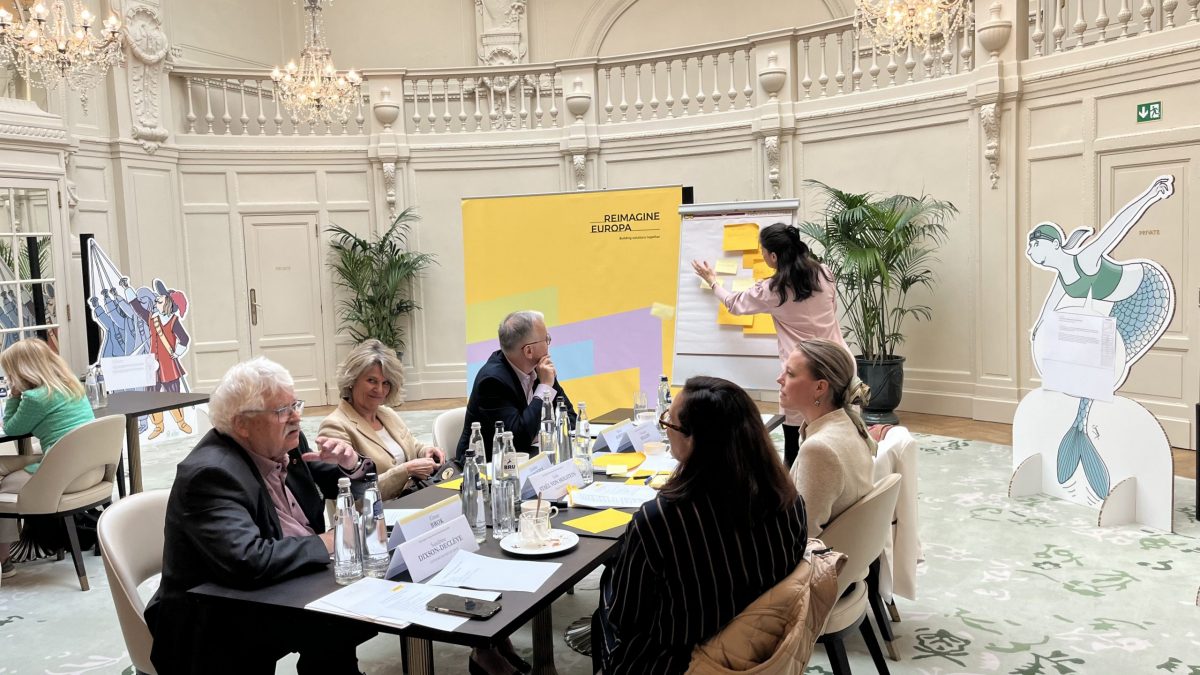
At a recent meeting of Re-Imagine Europa’s Advisory Board in Brussels, the dialogue shifted from the standard diagnosis of European challenges toward a far more ambitious goal: building a new narrative for European global leadership in the digital age. For the European Narratives Observatory (NODES), this meeting provided a vital testing ground for our research. The consensus among board members, including Chair Maria João Rodrigues, confirmed a core NODES hypothesis: Europe has too often defined itself reactively, caught between a fading global order and a pervasive pessimism. To break this cycle, we must apply a rigorous, evidence-based approach to reframing Europe’s narrative as the global leader of a new digital civilization.
A central pillar of the NODES methodology is the identification of “imitation traps” that impede our vision. For years, Europe’s technological ambitions have been measured against the Silicon Valley model, emphasizing scale and speed over social cohesion.
Through our narrative analysis, we have identified that this framework is fundamentally incompatible with the European social contract. Our research advocates for a shift toward a “human agency” frame. In this model:
-
Regulatory Safeguards are no longer seen as “red tape” but as strategic assets.
-
Social Welfare and Labor Protections are reframed as the foundations of a stable digital ecosystem.
-
Innovation is aligned with individual autonomy rather than just market dominance.
By reframing these perceived “weaknesses” as distinctive comparative advantages, the REFRAME methodology helps position Europe not as a follower, but as the architect of a new digital civilization.
The Advisory Board’s deliberations highlighted a nuanced understanding of strategic autonomy—one that aligns closely with NODES’ work on narrative coherence. Autonomy is not merely about defense or supply chains; it is the capacity to govern on one’s own terms.
As highlighted by some members of the Board, Europe possesses immense private wealth and technical expertise, yet these resources remain under-mobilized due to a narrative of “cautious management.” To shift toward a narrative of “deliberate shaping of the future”, we must bridge the gap between shared aspirations (security, purpose, and belonging) and institutional policy.
A common “narrative trap” in current discourse suggests that autonomy and global engagement are opposites. The Observatory’s analytical framework suggests the opposite: Autonomy and interdependence are mutually reinforcing.
As highlighted by Chief Executive Erika Staël von Holstein, the current “crisis of leadership and imagination” is also a moment of immense opportunity. The NODES methodology provides the tools to navigate this:
-
Dismantling the Isolationism Myth: A stronger Europe is a more credible and influential partner worldwide.
-
Purposeful Cooperation: Shifting the narrative from “reactive engagement” to “strategic partnership” based on European priorities.
The Advisory Board’s call for a more assertive sense of purpose reinforces the necessity of the work we do at the Observatory. Providing the scientific framework for Re-Imagine Europa’s vision is not just about words; it is about providing the cognitive blueprints for a stronger Union.
As we continue to develop the REFRAME Methodology, our goal remains clear: to ensure that the European narrative is grounded in its own values, powered by its own capacities, and directed toward a future it has deliberately chosen to shape.
Reframing is the first act of leadership.