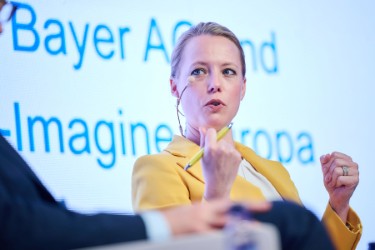
For years, a persistent and damaging narrative has dominated Europe: the idea that we must choose between the cold, hard logic of industrial innovation and the moral imperative of sustainability. A zero-sum game that suggests one can only thrive at the expense of the other. But at a recent gathering at the Institute of Natural Sciences in Brussels, a different story began to emerge—one that treats this divide not as an innevitable reality, but as a “narrative trap” that can, and must, be dismantled.
During a fireside chat at the event “Back to Growth: Innovative Life Sciences for a Competitive Europe,” Erika Staël von Holstein, CEO of Re-Imagine Europa and the NODES Observatory, and Bill Anderson, CEO of Bayer, addressed the paralysis currently gripping the European center. Staël von Holstein started by challenging a common misconception: that innovation and sustainability cannot exist together. The idea that innovation cancels out sustainability (and vice versa), is, according to the CEO of RIE, one of the most common narrative traps we face in society today, and a barrier for progress. “It is time to build a narrative that brings together innovation and sustainability, creating a shared vision where they advance hand in hand into the future”, she stated.
Anderson described a Europe caught in a “war of extremes,” where the political middle is so preoccupied with defending a crumbling status quo that it has lost the agility to lead. “Often the center is so busy defending the status quo,” Anderson noted, “that it cannot move beyond realizing that big changes are needed.”
Both speakers agreed that the path forward requires more than new policies, it demands a shift in mindset and the creation of shared narratives that can unify diverse stakeholders. To build a shared narrative for Europe is not to impose a single viewpoint, but to create a framework where diverse stakeholders—from life science pioneers to environmental advocates—can see their priorities reflected in a common goal. As argued by Staël von Holstein, these narratives are “instruments for listening and understanding different perspectives.”