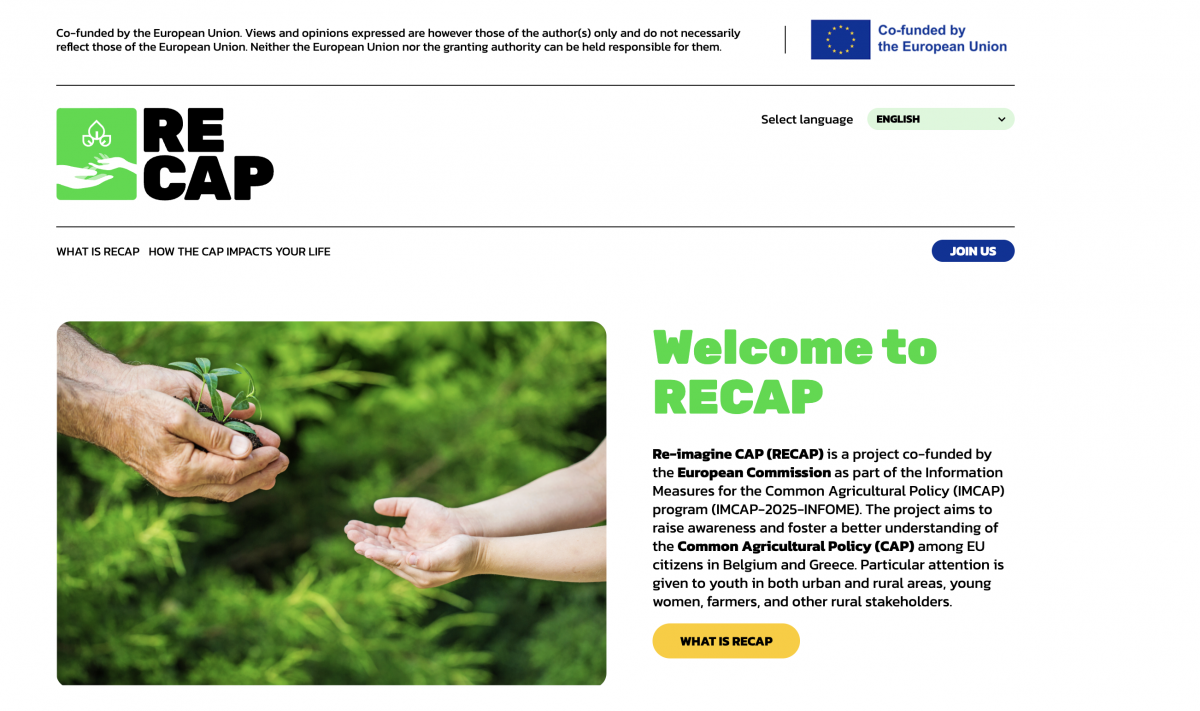
The Common Agricultural Policy (CAP) is one of the European Union’s most enduring pillars, yet it currently exists within a deeply fractured narrative landscape. Despite its role in securing food systems and advancing climate action, the public discourse surrounding the CAP is frequently characterized by “narrative silos,” misinformation, and intense polarization. At the European Narratives Observatory (NODES), we view this not as a communication failure, but as a methodological challenge. Through the newly launched RECAP project (RE-imagine CAP), Re-Imagine Europa will apply NODES’ research and RIE’s unique REFRAME Depolarisation Methodology to analyze, understand, and ultimately rebuild the narratives that connect European citizens to the land that sustains them.
The first phase of the RECAP project, centered in Belgium and Greece, utilizes the Observatory’s research tools to map the current “Narrative Architecture” of the CAP. Our preliminary analysis indicates that the policy is often caught between two conflicting and incomplete frames:
-
The Bureaucratic/Technical Frame: Which alienates citizens by focusing on complex subsidies and regulatory compliance.
-
The Conflict/Crisis Frame: Which pits environmental objectives against agricultural viability, fostering a zero-sum mentality.
By identifying these dominant narratives, NODES provides the scientific foundation for RECAP to move beyond reactive messaging and toward proactive reframing.
The REFRAME Methodology
The RECAP project serves as a vital laboratory for the REFRAME Methodology. Rather than simply “providing facts,” the Observatory focuses on the cognitive structures that determine how those facts are received. Our approach to the CAP involves three distinct methodological steps:
-
Narrative Mapping: Using data-driven tools to identify where misinformation enters the agricultural discourse and how it takes root in specific demographics, particularly among young people in urban and rural areas.
-
Identifying “Value Anchors”: Our research looks for shared aspirations—such as food security, rural vitality, and environmental stewardship—that exist across polarized groups. These anchors serve as the basis for new, constructive narratives.
-
Cross-Generational Bridge Building: By focusing on young farmers in Greece and students in Belgium, the methodology tests how reframed narratives can foster a sense of “local ownership” and “civilizational pride” in European farming practices.
Testing the Narrative Shift
To ensure these reframed narratives resonate, the RECAP project integrates NODES’ research into innovative engagement tools. From podcasts and educational workshops to a CAP-themed board game, each output is a vehicle for a verified, positive narrative designed to counter the “inertia of pessimism.”
By meeting citizens in their own digital and physical spaces, we are testing the efficacy of narratives that frame the CAP as a vital component of the European story—a policy that ensures not just “food for all,” but a resilient and inclusive future for the continent.
The ultimate objective of the Observatory’s involvement in RECAP is to foster narrative resilience. By providing citizens with a more balanced and nuanced understanding of agricultural policy, we strengthen the social contract between the Union and its people.
At NODES, we remain committed to proving that when you change the narrative, you change the possibility of cooperation. The RECAP project is a significant step toward a Europe where agriculture is no longer a point of division, but a shared horizon of innovation and sustainability.