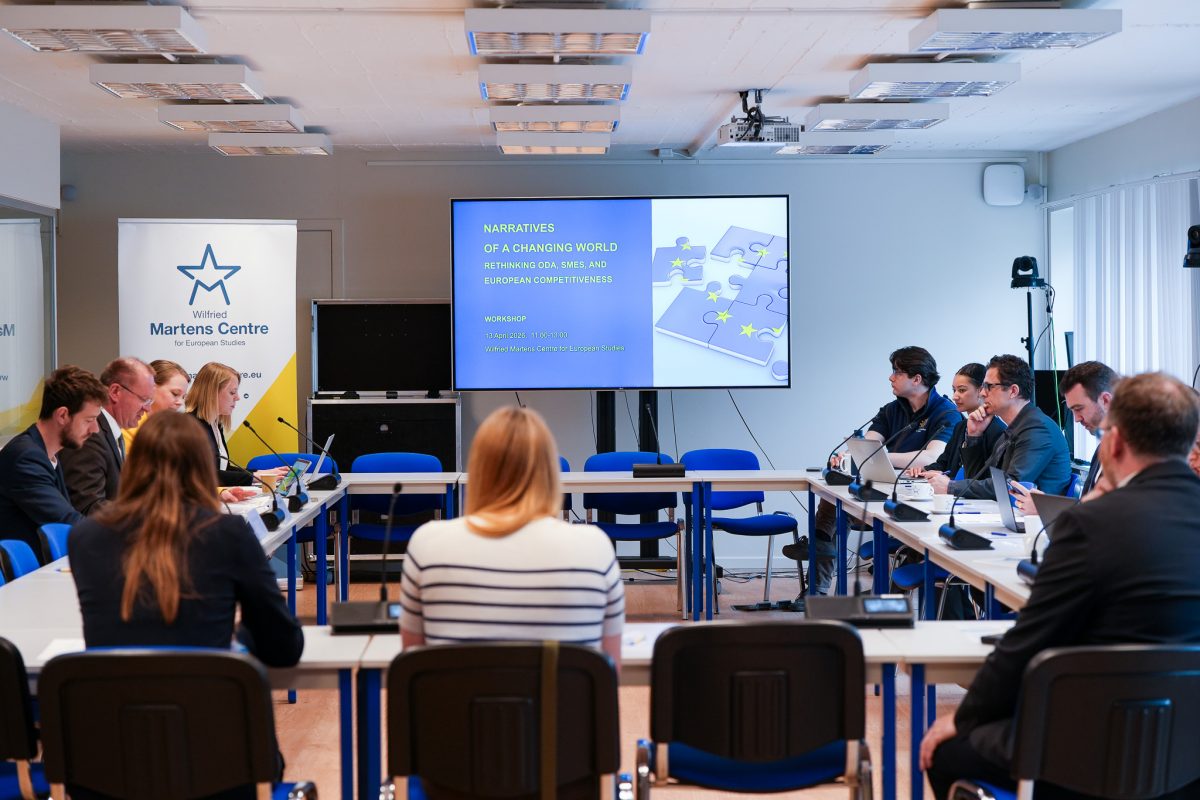
As global power dynamics shift and fragment, Europe’s most formidable borders are not physical, but conceptual. Addressing a high-level roundtable hosted by the Wilfried Martens Centre for European Studies, Erika Staël von Holstein, Chief Executive of Re-Imagine Europa and the European Narratives Observatory (NODES), argued that the ‘mental frames’ through which we perceive our global role are totally outdated. “The narratives currently governing European international cooperation are no longer fit for purpose”, she argued, setting the tone for a rich dialogue among twenty-five leading figures from politics, industry, and civil society.
For decades, the “charity-dependency” frame has been the silent architect of European global strategy. While rooted in a history of Official Development Assistance (ODA), our research at NODES indicates that this narrative has become a strategic bottleneck. It creates a unidirectional relationship that fails to account for the complexities of a digital, multipolar civilization. To build a truly competitive and autonomous Union, Europe must pivot. We must move toward a narrative of mutual strategic benefit, where international cooperation is not an act of benevolence, but a driver of shared prosperity and resilience.
At the heart of the discussion was the application of the REFRAME Methodology, a system developed by NODES to dismantle legacy frames and reconstruct narratives based on contemporary reality.
The roundtable, titled “Narratives in a Changing World: Rethinking ODA, SMEs, and European Competitiveness,” highlighted three essential pillars for this narrative shift:
-
Dismantling “Narrative Traps”: Current frameworks often view partner regions—most notably the African continent—through a narrow lens of instability. This perception causes Europe to miss immense landscapes of demographic dynamism and innovation. By reframing these regions as landscapes of opportunity, we foster partnerships rooted in local ownership and mutual respect.
-
The SME Bridge: SMEs are the undisputed backbone of the European economy, yet they remain sidelined in international frameworks by bureaucratic inertia. A reality-based narrative recognizes SMEs as the primary engines of global value-chain resilience. Engaging them is a strategic necessity, not just an economic priority.
-
Coherence of Power: Our domestic strength and our international actions are two sides of the same coin. Europe’s distinctive comparative advantages—reliability, regulatory stability, and the rule of law—only manifest when our narrative aligns our internal priorities with our global ambitions.
The consensus reached among participants—including MEP Dr. Peter Hefele (Policy Director of the Martens Centre) and Sybren Devoghel (General Manager of Exchange vzw)—underscored a growing appetite for this shift.
However, participants agreed that this shared vision is only the first step. The challenge for the European project is to translate these methodological insights into transformative policy. At the European Narratives Observatory, we remain dedicated to providing the data-driven tools and research necessary to ensure that Europe’s global role is defined by ambition, reality, and a commitment to shared prosperity.
When we reframe the narrative, we redefine the horizon of the European future.