“You furnish the pictures, and I’ll furnish the war.” This infamous directive from media tycoon William Randolph Hearst during the Cuban Independence War remains one of the most chilling examples of narrative engineering. By deploying “Yellow Journalism” to frame the Spanish as subhuman “brutes,” Hearst advanced a fundamental truth that the European Narratives Observatory (NODES) studies today: narratives that anchor themselves in a community’s deepest fears can reshape public opinion—and reality itself—in a matter of weeks.
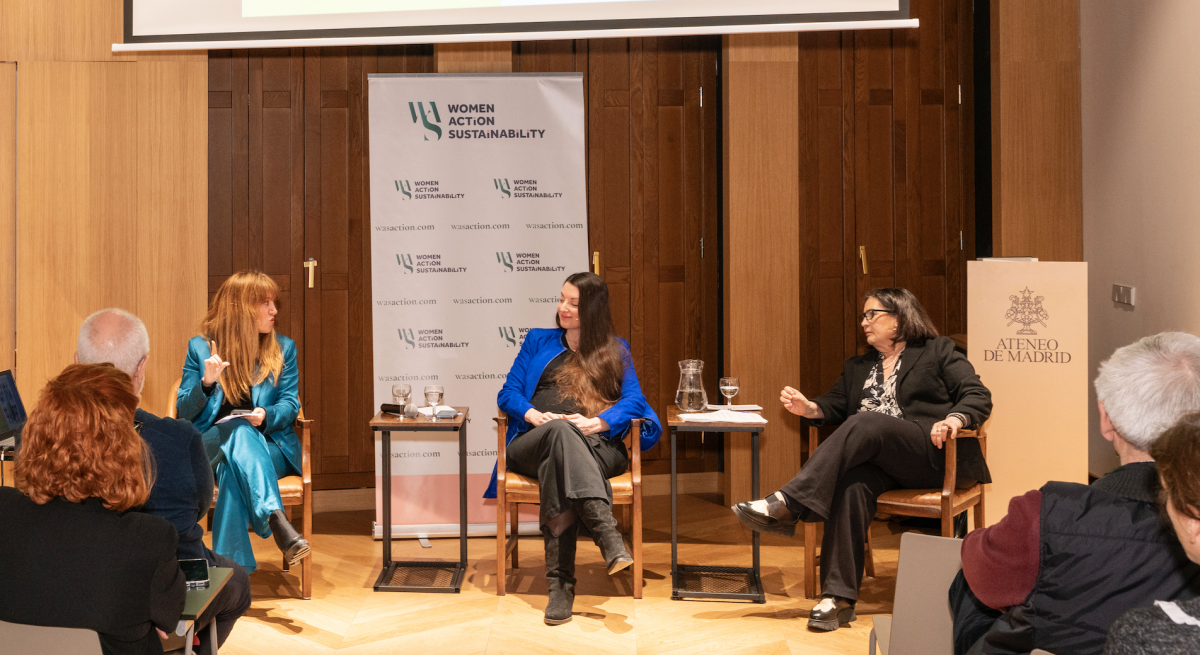
At a recent forum organized by Women Action Sustainability (WAS) in Madrid, Lydia Aguirre – Re-Imagine Europa’s Chief Communications Officer, explored how these same mechanics are currently driving global polarization by presenting the key findings of the European Narratives Observatory’s research.
Addressing polarization requires first to understand how the human brain processes information. As explored during the WAS session by neuroscience expert Zoe Seoane, our perceptual processes do not merely “receive” reality; they actively construct it.
Aguirre explained how narratives appeal to ingrained beliefs and worries, bypassing analytical filters. This creates a “Cycle of Distrust” where individuals only perceive information that fits their existing mental framework; “the other” is no longer seen as a fellow citizen with a different opinion, but as a threat to one’s core identity; and communication breaks down because the “meaning” of words has fragmented across different communities.
NODES Methodology
The work developed by NODES, the research arm of Re-Imagine Europa, offers a scientific way out of this cycle. By applying the REFRAME Methodology, we move beyond the symptoms of polarization to address its structural causes.
1. Mapping the “Cycle of Distrust.”
Taking the Sustainable Development Goals (SDGs) and climate change as primary case studies, NODES research identifies how “Narrative Traps” create blind spots. These traps are often intentionally set by actors looking to radicalize discourse for political or economic gain.
2. Identifying Value Anchors
Behind every polarized discourse lies a set of “Value Anchors”—deep-seated human needs for security, belonging, or purpose. Our methodology deciphers these narratives to find the common values hidden beneath the surface of the conflict.
3. Building Narrative Bridges
Once these anchors are identified, NODES helps institutions build “Narrative Bridges.” These are not “compromises” that please no one, but rather new, inclusive narratives that allow different communities to find mutual understanding without sacrificing their core values.
Depolarization Manuals
The insights generated by the Observatory are not purely theoretical. They are translated into practical tools for public and private institutions. Our Depolarization Manuals provide actionable strategies for organizations navigating highly sensitive topics such as climate action, migration, pandemics, Artificial Intelligence or Official Development Assistance (ODA), among others.
Through these manuals, NODES empowers leaders to foster more constructive dialogues, ensuring that the “pictures” we furnish for the public are not intended to start wars, but to build a more resilient and united European project.
If narratives can be used to promote hatred, they can also be engineered to promote cooperation. At NODES, we provide the science to make that reframing possible.